

The need: The ideal gym would be located close to home or work, well equipped, clean and manned by knowledgeable, helpful staff. Our ideal gym would also not be overly crowded yet available to friends and family that we’d like to work out with. An ideal gym would be supportive of hard-core fitness, à la CrossFit. As long as we’re dreaming, it might also play only the music that we want to hear.
Many of us are blessed with gyms we love dearly. If that’s your situation, great! For the rest of us, our gyms are very different. Often the drive to the gym is 20-30 minutes coming and going, the music is worse than annoying, the staff are less than worthless, the place is packed with selectorized equipment for which we’ve no use, and the few pieces of equipment that you want to use are in near-constant use.
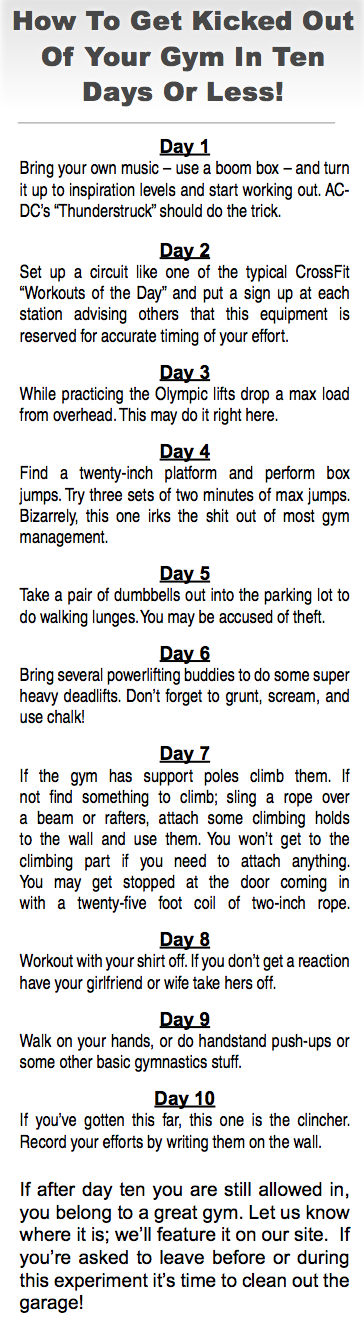
Commute, parking, filth, rust, crowding, music, staff and members each can make what for us is an essential activity difficult or impossible. The “Spa” (big tip-off) in our neighborhood has over the years banned Olympic lifting, all jumping, plyometrics, walking lunges—believe it or not—and has as a matter of policy fostered an antagonistic attitude to serious training. No grunting, sweating, yelling or dropping weights allowed. Our experience is not unique.
In part the problem is one of business model. Your average neighborhood health club or gym is predicated on a low-to-minimum-wage, skill-less staff supervising hapless members. The idea is to fill the space with machines, staff it with high-school kids and let Muscle and Fitness provide the technical guidance. The predominant model in commercial facilities is the bodybuilding model: all machines and isolation work. Machines and isolation movements require little or no knowledgeable instruction or coaching, whereas serious strength and conditioning requires less equipment and considerable expertise on the part of coaches. You can see this in the National Strength and Conditioning Association’s, landmark “Essentials of Strength and Conditioning,” where schematics of a university strength-and-conditioning facility and a commercial health club are shown. The schematics speak volumes. You’ll notice that the commercial facility is littered with equipment whereas the university strength-and-conditioning facility is sparse by comparison.
At CrossFit we routinely receive email from athletes complaining that their gym doesn’t have bumper plates, training/practice plates, rings, parallel bars, climbing ropes, plyo boxes or some other piece of gear essential to our practice. The solution to this dilemma has been solved by many of these same clients: building a garage gym.
Now, when you look at the sea of worthless machines that makes up a commercial facility, the idea of developing a garage gym may seem daunting. Just remember, we’re building a strength-and-conditioning gym, not a bodybuilding gym. We wouldn’t keep 99 percent of the equipment at your Gold’s Gym if it were given to us.
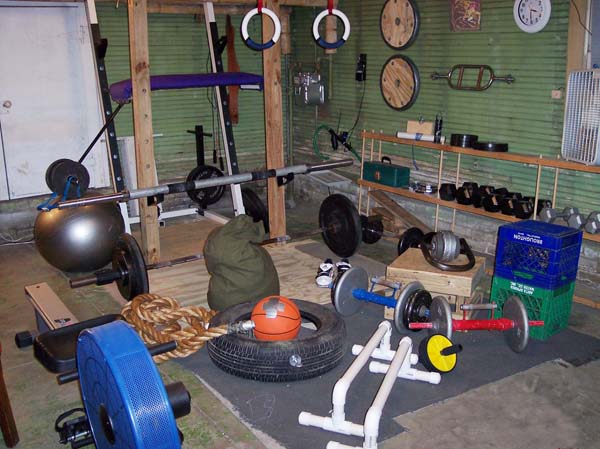
A well-appointed garage gym is more effective than the largest commercial facility full of bodybuilding equipment.
The Cure
Here’s the great news: You can build, rather inexpensively, a world-class strength-and-conditioning facility in your garage! At the CrossFit facility in Santa Cruz, California, we’ve picked up every piece of equipment critical to forging world-class athleticism, and many of our clients have the same stuff at home. Our facility is in fact little more than an oversized high-ceiling garage. There’s no piece of equipment that we need but don’t have—not one. The same is true of our clients who’ve built their own facilities. They’ve got exactly what they need.
The garage-gym tradition is revered and respected. The number of athletes training in garages, barns and abandoned buildings is legion. Many of these are world dominant in their sport. Some go this route because no other resources are available, but most have chosen the garage gym realizing it best provides for their needs. The lifting, throwing, jumping and climbing essential to responsible programming will find no welcome home for you and your friends at 24-Hour Nautilus.
Your garage is begging to become a gym. There is within your garage more than enough space to develop a gym that will rival just about any commercial facility. Yeah, we know, your car and 15 years worth of accumulated junk make current use of that space. What we’re talking about here is repurposing your garage from junkyard and auto shelter to a first-rate strength-and-conditioning facility. Pull the car into the driveway. Cover it if you must. Have a garage sale for the junk of value. You can erect a Rubbermaid storage shed in the back yard for all your gardening equipment, tools and other things you want to keep. The rest throw away! If your garage is full of “stuff” that you don’t want to keep, the easiest solution is to rent a disposal bin. The rental yard will drop the bin off and come back for it and dispose of the contents when you’re done. It’s easy!

Stall mats can be cut to fit, but use your fitness to do so and avoid power tools that will cause fires and smoke.
Starting From the Ground Up: Matting
Once the garage is cleared and cleaned, the next obvious step is to mat it. Matting is expensive but adds so much to comfort and safety that they are a must. Install in installments, one mat at a time if you need to.
Avoid buying your mats from fitness vendors. You can find 4-foot by 6-foot by three-quarter-inch rubber mats exactly like the ones sold by Bigger Faster Stronger (one of our favorite vendors) at your local horse feed-and-tack store. The same mats are sold by feed-and-tack stores as horse-stall mats. Even if you have to rent a truck and drive two hours out of Manhattan to find a feed-and-tack store you’ll save a bundle by not paying for shipping. The mats are 50-60 lb. apiece, and the shipping is outrageous. You’ll need one mat for each 24 square feet of garage.
We recommend that you draw your garage to scale on a paper and you’ll see how many mats you can lay without cutting and how many you have to cut. Cutting the mats is not easy! In fact, it’s really, really hard. The best approach is to make a template out of brown shopping bag that fits the space for which you want to cut a mat. Lay the brown bag out on the mat to be cut and trace with white chalk the line you want to cut. Cutting three-quarter-inch rubber matting is best achieved with a utility knife. Use a 4-foot steel or aluminum rule to draw your lines and to make the first pass with the knife. It will help to draw your lines approximately one-quarter-inch past what you’ve measured. Due to the compressibility of the mats, this allows for really tight, nice seams.
Let only about a half-inch of blade out and from your belly with arms out straight overhead draw the knife toward you along the chalked line. Each cut will only be about 18 inches long and about a quarter-inch deep. So, it will take three passes to get through. Don’t cut over the cement or on any surface you don’t want to ruin. We recommend a sheet of plywood under the mats you are cutting.
This is one chore where a friend is almost essential. You’ll want help loading and unloading the mats and measuring, cutting and fitting them. They are only 50 lb. or so but couldn’t be more awkward. They feel like they weigh 300 lb. apiece by the end of the day. This chore requires patience.
Don’t even think about using a skill saw or other power saw. The resulting fire and smoke will take hours to clear, and that’s from a 6-inch cut. We’ve seen first-timers make near-perfect cuts around poles and corners using just a utility knife. Careful work and positioning of the mats will minimize seams and gaps. We use a 25-lb. plate to slide into the mat’s edges to cram them together, shrinking gaps before laying the next mat. This is the hardest part of the garage gym.

A barbell is a required tool that’s incredibly versatile.
Bare Minimum: Weights and Pull-Up Bar
You want to get an Olympic weight set. These have the rotating sleeves and accept plates with the 2-inch holes. You’ll never regret buying a quality bar. It will set you back several hundred dollars but provide a lifetime of service. Bigger Faster Stronger and IronMind are our favorite vendors, and Ivanko, Eleiko and York are our favorite manufacturers. You may want to think about Bigger Faster Stronger’s “Aluma-lite” and “Ultra- lite” bars if your gym is going to be used by women, seniors or children. These bars weigh 15 and 30 lb. respectively. We have and use both. A standard Olympic Bar is 45 lb. If you are going to be working out with buddies, you are going to want two Olympic bars. As far as plates go, we highly recommend that you go with solid rubber composition plates. These plates are safer and quieter than steel and even regular bumper plates. If we were outfitting our facility again we’d go all rubber and almost no steel. The only steel we need is 2.5-lb. plates. Bigger Faster Stronger has non-composition rubber and plastic 5- and 10-lb. plates. The rubber composition plates are made by both Hampton and York and come in 25-, 20-, 15- and 10-kg weights. The rubber plates cost more, but the noise reduction alone makes them worth the money.
You’ll want an Olympic bar and Olympic bumper-plate holder. It’s annoying and unsafe leaving this equipment on the floor. The bar holders that hold the bars on end take up little space. If your plates are all full-sized bumper or rubber composition plates, make sure your rack is designed to hold Olympic bumper plates. These plates are all 18 inches in diameter. We’ve made this mistake in ordering racks. We don’t have a preferred vendor for these items.

A pull-up bar is absolutely essential.
Dumbbells are not absolutely essential, but we wouldn’t be happy without them. Our favorite is the Durabell Dumbell made by Hampton and carried by York Barbell Company. They are super durable, rubber coated, and won’t come apart and drop plates in your mouth. Best of all they store in vertical racks that take up little room. This is a great dumbbell and racking system at a great price. We paid a lot more for a lot less, unfortunately. Where budgets and space are tight you want to consider IronMind’s “Olympic-Style Husky Handle Dumbbell Bars.” These dumbbells have to be seen and handled to be believed. They take Olympic plates and are thick handled (2 inches). You’ll never outgrow these monsters. People’s jaws drop when they see them.
You need a place to perform pull-ups and dips. The temptation is to go with one of the many freestanding pull-up and dip towers. They are cheap and adequate to the task but flimsy and take up valuable floor space. In our garage gym we place a premium on floor space. Power Systems makes a wall-mounted pull-up bar and dip bar. We’ve had trouble with equipment coming damaged from Power Systems, but these items are very sturdy and ultimately Power Systems made good on the damage. You can also have wall-mounted pull-up and dip bars made by a local welder.
We had Nick Massman build CrossFit a pull-up bar and mounting brackets that is 20 feet long. We also commissioned Nick to design and fabricate a thick-handled (2-inch diameter) revolving pull-up bar. This monster will take someone with 30 pull-ups and bust them down to five reps. The load on the hands and forearms is amazing.
There’s another angle to pull-ups and dips. We have in our facility two Stairmaster Gravitrons. They have proven indispensable to developing pull-ups and dips in individuals not strong enough for either the pull-up or the dip. The pull-up and dip are unsurpassed in developing functional upper-body strength and are formidable obstacles for most women and seniors. For them the Gravitron is indispensable. If you can’t do pull-ups or dips you need a Gravitron. If you already have pull-ups and dips the Gravitron is still a great tool to work additional reps when spent or for warm-up. The newer Gravitron allows for lowering of the carriage and provides a station for unassisted pull-up and dips. Though far from cheap they have been indispensable to CrossFit’s practice. Some of our friends have found remanufactured Gravitrons for nearly half of the new price. Search the internet for used Gravitrons.
If you only had a bar and a place to do pull-ups you could do an acceptable variant of the CrossFit Program. With this minimal amount of equipment you could do deadlifts, squats, push presses, push-ups, cleans and pull-ups. In fact, the minimalist/low-budget approach to our program is to do deadlifts and Tabata squats on Day 1, push presses and push-ups on Day 2, cleans and pull-ups on Day 3 and rest Day 4. Repeat. In minimalist/low-budget mode we derive our metabolic conditioning from running and jumping rope. You could get amazing results on this regimen. Our desire here, though, is to lay plans for a world-class strength-and-conditioning facility in your home. Let’s proceed with the rest of our design.

Simple squat racks can fit most spaces and are movable for storage.
The Benches and Racks
Now we want to get some “furniture.” You will need to have a flat bench, squat racks and “portable power racks.” Iron Mind is the first choice for these critical pieces.
Squat racks are the next most important piece of equipment after your Olympic bar and pull-up bar. The Iron Mind squat racks are called “Vulcan Racks.” They weigh only 50 lb. yet can support 1,500 safely. They are adjustable from 37.5 to 64 inches, making them ideal for squatting and pressing, bench or standing. The more we use these racks, the more we like them. They are used at the U.S. Olympic Training Center as well as at CrossFit. IronMind also makes dipping handles that transform the Vulcan Racks into a reasonably stable dipping platform.
The Iron Mind flat bench (“Five Star Flat Bench”) is built to last forever. This all-steel bench is the perfect bench for bench press, though we’ve found it handy for dozens of other uses from step-ups to reaching our pull-up bar. We’ve seen cheaper ($280 with shipping) but not stronger benches.
Iron Mind’s “Pillars of Power” are in a sense portable power racks. These bomb-proof racks—they will support 4,000 lb.—are a perfect tool for self-spotting bench press and squats as well as an excellent loading platform for numerous exercises. Spotting is always a dilemma when working out alone. The Pillars of Power are actually a better spotter than a workout partner for the bench press and squat.
The beauty of the Vulcan Racks, Five Star Flat Bench and Pillars of Power is that they are professional-grade equipment in use by hardcore lifters worldwide, they can be tucked away to fit in the smallest of spaces, and they are perfectly portable. You are not compromising with this stuff. Programs with multi-million-dollar budgets and acres of space are using this same gear. We’re talking about some of the best training equipment available at any price!

Concept2 rowing machines store upright and take up little space, making them perfect for the garage.
Our Favorite Piece of “Cardio” Equipment
A jump rope, good bike, running shoes and the Concept2 Rower. That’s the CrossFit cardio equipment list. Let’s take a look at the rower.
Our favorite piece of equipment for metabolic conditioning (“cardio”) is the Concept2 Rower. The effect of rowing has to be experienced to be believed. Many of our world-champion fighters are terrified of the rower! Often a good thousand-meter effort leaves an impact on the body that lasts for days. The claim of a complete or whole-body exercise is often made and seldom true. Rowing is as complete as any single exercise can be. As for the Concept2 Rower itself, they are cheap ($800), virtually indestructible and essentially maintenance-free. We’ve seen Concept2 Rowers that have been in daily commercial use for years and years without any maintenance.
Concept II has an outstanding website where rowers post their times at varying distances grouped by age, gender and weight. The pool of athletes is deep enough that the posted times legitimately reflect a world ranking. This is possible because the Concept2 Rower (C2) is a common and valuable tool of internationally competitive rowers. Concept2 has turned its product into an international sport. We don’t know of any other product that can make a similar claim.
The console on the C2 is our favorite on any cardio equipment. On this rower we can easily program any interval pattern we want, such as the Tabata interval (20 seconds of work followed by 10 seconds of rest, repeated 8 times). The C2 console allows us to row for time or distance and gives projected times and distances, making targeted efforts easier. It’s unbelievable to us that this flexibility is unique to this equipment.
The Concept2 Rower stores on end, and in this position takes up less space than most other common pieces of cardio equipment. Only running and jumping rope require equipment (shoes and rope) that stow away as compactly as this rower.

Once common in gymnasiums, rings are absent from almost all commercial gyms.
Gymnastics and Climbing Equipment
Because gymnasts have an extraordinary strength-to-weight ratio and unrivaled torso/upper-body strength, and because they can express this strength in a multitude of planes, CrossFit makes regular use of skills and drills that develop this capacity. Other than the pull-up bar and dipping platform already mentioned, we have parallettes (short parallel bars) and still rings.
Our parallettes came from AAI and are marketed as “low parallel bars.” AAI’s low parallel bars cost $844. They are adjustable from 14 to 20 inches wide, stand 16 inches high and are 8 feet long. While unwieldy and somewhat large, this is one piece of equipment you’ll never outgrow. Presses to handstands, handstands, push-ups, pirouettes, L-holds, V-holds—the list of exercises that can be learned on these is extensive. This is an ideal place to develop upper-body strength, abdominal strength, agility, balance, coordination and accuracy.
Space and budget may not allow for the commercial bars, so here are plans for homemade parallettes. Made from PVC, these bars will allow for much of what you can do on the bigger set. From the Drills and Skills site: Parallette Construction. Incidentally, this is one of our favorite sites. The Skills and Drills Page will keep you motivated and challenged for decades.
We strung a pair of still rings from our vaulted ceiling. You may not have the great luxury of a 15-20-foot ceiling. That doesn’t mean you can’t take advantage of the incomparable upper-body strength that can be developed on the rings. You can get a pair of rings and straps from Professional Athletics (PA). PA carries Norbert’s wood rings and straps for about $125.
We’ve seen these rings hung over a wall- or beam-mounted pull-up bar, allowing for muscle-ups (pulling yourself from a hang below the rings to a support above and dipping to full extension) and dips. The difference in difficulty between bar dips and ring dips is a source of unending entertainment. That’s all we’ll say about that.
As for the muscle-up, you just think you’ve got good upper-body strength until you’ve actually done one. The muscle-up combines the world’s nastiest pull-up with the hardest dip. The muscle-up is a functional movement that enables you, once you’ve mastered it, to surmount any object on which you can get a finger hold. This is potentially a life-saving skill. We’ll cover the muscle-up in great detail in a later issue, but let it suffice to say for now that the muscle-up is an indispensable tool for developing stupefying upper-body strength. Learn the muscle-up; you can’t without rings. Finally, the wooden rings and strap assembly hung over your pull-up bar is the ideal solution as to where to do dips.
We also use landing mats from AAI for stretching and to cushion a possible fall from the parallel bars, rings or rope climb. Our favorite mat is 3.5 feet by 6 feet by 4 inches.

Climbing ropes and cargo nets make for a great gymnastics workout.
Rope climb is an extraordinary exercise yet requires a tall ceiling. Some of our friends have strung a rope in a tree in their yard. If you had a garage with exposed rafters you could string a shorter rope and start from seated and make multiple trips up and down for great effect. Our rope came from AAI, but it was expensive. AAI’s ropes are absolutely beautiful, come in custom lengths and are booted or braided/knotted at the end to prevent unraveling. AAI Climbing Ropes also come with mounting hardware. They have several styles including one with braided knots every 12 inches to assist the beginner.
You won’t find a better rope than AAI’s, but you can put together a climbing rope at a fraction of the cost. One of our friends bought a length of 1-and-a-half-inch twisted manila rope, ran an eye bolt through a beam, passed the rope through the eye and tied a knot in the end to keep it from coming through. If monitored regularly for wear and fraying, this is perfectly safe. The floor end needs to be knotted or “whipped” to keep from unraveling. This is not a pretty solution, but there’s no compromise in function with this approach.
The climbing rope might or might not be an option in your gym, but there are several other climbing options that are possible in any space. Climbing holds, campus boards and peg boards are wickedly effective, functional and fun. We’ve limited experience with this stuff, but it is our next frontier.
We’ve plans to fill our walls with climbing holds. This is cheap and beautiful, and it takes no useable space. And it’s functional. You could put hundreds of these up in your garage. Search Google for “climbing holds.”
They mount to plywood, and the plywood mounts to your walls. The vendors will supply all the hardware and instructions for installation. This is a must for a garage gym in our opinion.
Campus boarding is great exercise. Metolius sells the equipment. CrossFit plans to install a campus board within the next few months. Again, great functional exercise, doesn’t take from otherwise useable space and fun!
Peg boards can be used to develop great back and arm strength. Again, we’ve plans to install peg boards on our walls soon. This is our favorite alternative to the climbing rope. This is, perhaps, a limited option with a low ceiling.
As a note, weight training generally lacks in pulling movements compared to pushing movements. This is why we place such an emphasis on gymnastics and climbing in our program. The climbing rope, campus board, climbing holds and peg board all give great work emphasizing the back and arms as well as the hands and forearms. These apparatus are invaluable to rounding out your program.

GHD machines can be used for hip/back extensions and sit-ups.
Trunk Development Equipment
CrossFit’s trunk work comes primarily from hip/back extensions and sit-ups performed on a glute-ham developer and abdominal work done on our “ab bench” and AbMat. The rest of our trunk work is calisthenics movements that, of course, require no equipment.
Our glute-gam developer (GHD) came from Power Systems. It came late, broken, poorly welded and to this day wobbles a little like a bad table that needs a matchbook under one of the legs. Though a mess, we had it fixed, and Power Systems gave us a refund large enough to forgive the shoddy workmanship and most of the frustration. Many of our friends have gone with the Bigger Faster Stronger GHD. It’s just “OK.” We’re not convinced we’ve seen the best of the GHD’s on the market. If we were to replace ours we’d go with Sorinex.
The science behind both the AbMat and the “ab bench” is perfectly brilliant. Koch, Blow and Jacob are responsible for the research and understanding behind these products. You can read about and order the AbMat from AbMat.com. Order fulfillment has been troublesome to say the least, but none of our friends have been ripped off. It just feels like it waiting months for your mat to arrive. This is one of the best $30 investments you can make. Some of our friends have made their own after giving up on delivery.
The “ab bench” incorporates the same science. We paid $300 for our ab bench and we were heartbroken when we saw the quality of the product. It’s fairly cheesy. The price has fallen to $169, which is a lot better, but we put Nick Massman on the task, and we got a much, much better ab bench with an improved design. Nick’s version of the ab bench is something we are proud of; the original is a “piece.”

Medicine balls and plyo boxes can be made cheaply or acquired from a host of suppliers.
Miscellaneous Basics
Plyometrics boxes are a simple and wickedly effective tool for both explosive/power training and metabolic conditioning. Timed box jumping is high-intensity functional exercise and a regular feature in CrossFit’s Workout of the Day. We have a full set of plyometrics boxes from Bigger Faster Strong but use the 20-inch box almost exclusively. We use the 10-inch box for “box squats,” both weighted and free. We recommend getting the 20-inch box, its booster and the 10-inch box. This gives you an excellent jumping box at three heights (the booster provides both a 2- and 4-inch boost depending on its orientation) and a box for box squats.
The two-arm kettlebell swing is a great exercise, and for that we purchased Pavel Tsatsouline’s kettlebell set from Dragon Door Enterprises. The set includes a 36-, 53- and 72-lb. kettlebell. With the exception of the two-armed swing, most of the kettlebell exercises have been more novelty than productive. Additionally, most of the exercises featured on Pavel’s videotape can be equally or better facilitated with dumbbells. Still, we recommend getting a set. The competitions have been a blast. We’ll frequently pit two athletes against one another to see who can keep swinging the big one overhead for the best time.
It may seem trite to cover, but there’s something to jump ropes. Our favorite jump rope came from Power Systems. The rope is marketed as the “Superope.” The Superope is billed as their fastest and most durable. Well, our Superope wore and broke after a year, but the rope was so fast that it was worth replacing even if it wore out at five times the rate it did. There are two general trends in the design of jumping ropes: heavy and fast. After years of experimentation with both, we’ve come down squarely on the side of the fast rope, and this one is lightning fast!
We have in our facility several Dynamax Medicine Balls. The Dynamax ball is a soft, low-bounce ball. Dynamax’s claims about the advantages of a less lively ball are proven the instant the ball bounces off your face, and it’s a certainty that given enough exposure this is going to happen. The manual that comes with the Dynamax ball is one of the best publications accompanying any fitness product.
We have two unique applications for medicine-ball training. The first is “wall ball.” Wall ball is essentially a deep front squat/push press/throw with a rapid recycle time. Nick Massman made a steel backboard for this drill.
In addition to the wall-ball drill, we use the medicine ball to teach the power clean and squat clean. This has been an extraordinarily effective drill to that end.

A dog is always a nice addition to a garage gym.
Miscellaneous Luxury Items
This brings us to our last piece of strength and conditioning equipment, Probotics “Just Jump or Run.” KBA Coaching carries the “Just Jump or Run, an electronic device that tests vertical jump, reaction time, sprint time and anaerobic fade. We had a lot of fun with this for a while, but we don’t use it much anymore, and I’m not sure if it was worth the $500 we paid for it.
As aids to instruction we’ve some specialized equipment that while being very useful for an instructional environment might have limited applicability for a home gym. Our facility has a 15-foot ceiling from which we’ve attached a block and tackle assembly from Harken with a 4:1 purchase. We use this with both heavy-duty leather padded ankle straps and a “Delta No-Tangle Harness Vest Style” from Sala. The ankle straps (from Power Systems) we use to spot and assist handstand push-ups and presses on the rings and parallel bars, and the harness we use to assist the muscle-up. If you’ve the ceiling height, budget and commitment, these items are of enormous benefit.
CrossFit also has a Sony digital video camera. Whether in a professional coaching environment or working out by yourself in the garage, you can’t see what it is that you are doing right or wrong without video. Eventually in your training this becomes more necessity than luxury, especially for the Olympic lifts and gymnastics movements. It’s cool.
You’ll need a stopwatch for your workouts. Our favorite comes from Stopwatches.com and is the Seiko S052 Interval Timing Stopwatch. This watch will time intervals of any work time, rest time and total interval count you choose. This is a gem of a watch for the Tabata interval. This great watch chimes a countdown for the work interval and the rest interval distinct from the end and beginning of the work and rest interval so that it can be used hands-free and without looking at the watch to time your interval training efforts. Once you’ve used this watch, other timing methods seem difficult.
We’ll mention here in the name of completeness that we also have at CrossFit two StairMaster StairClimbers and two StairMaster stationary bikes. They’re fun, good diversion but not critical.

Renovations at the original CrossFit gym.
Finishing
We recommend that you finish your garage in three-quarter-inch plywood. Lag bolted securely to the studs, the plywood becomes the perfect surface for mounting anything you want or need. If you finish most of the wall space with plywood, you can cover your walls with climbing holds and have perfect flexibility for mounting your pull-up bar, dip bars, campus board, peg board, etc. The look is also appealing and shows your pride in what you’ve built.
We’ve mounted sheets of marker boards on the CrossFit gym walls for use with dry-erase markers. You can buy 4-foot x 8-foot sheets of marker board for about $15 per sheet from most lumberyards. We record achievements for various efforts on these boards. This can provide a very public display of your accomplishments and in turn becomes a wonderful source of motivation. We didn’t know when we affixed these boards just how important they’d become. Now we couldn’t be without them. Neither should you. Take our word for it.
We have a wall-mounted monitor, satellite TV and music, and a full rack of audio-visual gear at CrossFit. Whether you’re blasting your favorite tunes, keeping an eye on the stock ticker before leaving for work, or running IronMind’s Bulgarian “Training Hall” Olympic-lifting videotape as background motivation, the total effect of an AV system is fantastic. We make extensive use of our system for entertainment, motivation and instruction.
Every garage gym should have a library, and there’s no better way to seed your fitness library (other than with the CrossFit Journal, of course) than with Milo. Milo is billed as “a journal for serious strength athletes.” Milo is incredible. Randall Strossen, the owner of IronMind, will live forever in fitness lore for publishing Milo. Milo is honest, gritty, homegrown and one of a very few legitimate journals in the fitness world. We wouldn’t trade a single issue of Milo for all the popular fitness magazines in the world. You’ll also want to get catalogs from the vendors we’ve mentioned here for your shelf. They are collectively a fine source of motivation and ideas. In a future edition we will make recommendations for material to flesh out your fitness library.
The final touch (in reality you’ll never finish, which is cool) is artwork. Throw your favorite sport or athlete into Google along with the words “poster” and you’ll be likely to find a poster that will be both entertaining and inspirational. If you don’t know where to start, just put “sport posters” into Google and start surfing. You’ll find more than you’ve time to look at.

A double garage will give you more room for gear and friends.
“Look What You’ve Done”
Don’t let the fact that your garage is only 400 square feet or so deter you. CrossFit’s gym is approximately 1,200 square feet and we routinely operate with three trainers and three to six athletes at one time. The typical garage is perfectly sized for an elite strength-and-conditioning program servicing a family or individual and friends. In truth, some of our friends have built their gyms in less than 200 square feet!
It needs to be explained that your home gym doesn’t aspire to be as good or complete as a commercial facility; your gym has the potential to be much, much, better. State-of-the-art strength-and-conditioning technology, like CrossFit, is more readily facilitated in a well-appointed garage than in a Gold’s Gym, World’s Gym, Family Fitness Center, 24-Hour Nautilus or Balley’s. These chains and gyms like them cannot support elite professional programming; you can.

An elegant solution to a problem: The original CrossFit gym in Santa Cruz, California.
It bears repeating: The commercial model is predicated on simple movements requiring little or no coaching and inexperienced, low-paid staff. This is the only reason bodybuilding practices permeate these facilities. Where lives and livelihoods depend on fitness, this model is woefully lacking. The professional strength-and-conditioning facility requires different equipment, cheaper and less equipment, but professional staff and instruction. CrossFit, through the CrossFit Journal, will provide that expertise. We know it can be done; we’ve done it for thousands through our website.
CrossFit endeavors to lead a revolution in fitness training, a radical departure from the ineffectual, non-functional prevailing bodybuilding model of the commercial gyms and toward the professional strength-and-conditioning model of the university, pro sports franchise and military. Your needs, regardless of your current fitness, differ from the professional or elite athlete’s by degree not kind. We’re waging this revolution in your home. That’s the only place it can be won.
If cost is an objection, you might consider reevaluating your priorities. If your living room, bedrooms, kitchen or dining room are well appointed, there’s no substance to the argument that you cannot afford your own gym, unless your health and fitness are lesser priorities than your leisure and entertainment.
The satisfaction derived from building your own gym and sharing it with your friends is sure to surprise you. Those that have gone this route find that with each modification or additional piece of equipment their enjoyment and pride increase.
But, I’m Broke!
If your budget is seriously limited here are some ideas:
- Start with an Olympic bar and some rubber composition plates and a pull-up bar. That’s enough to get started. You can find retailers in your area with what you need so that you can avoid shipping costs. They’re substantial!
- Make what you can. If you’ve the skill or know someone with the talents, much of our equipment can be fabricated for less.
- Shop around. Buy used. Gym equipment goes for pennies on the dollar at garage sales and in the classified section of your local paper. Make a habit of checking in with stores that sell used sporting-goods, the classifieds and the internet.
- You can mat your garage one mat at a time.
- Allocate a monthly budget for the project and be patient.
- Ultimately, be resourceful. If you want a gym nothing can stop you.
Click here to download the Garage Gym Equipment Shopping Checklist.
Click here to download the original PDF.
About the Author: Greg Glassman is the Founder and CEO of CrossFit Inc.
Cover image: Danny Bostwick